









More efficient Vacuum Ultraviolet laser Developed:
Vacuum ultraviolet laser may improve nanotechnology, power nuclear clocks
By Daniel Strain, University of Colorado at Boulder
More efficient Vacuum Ultraviolet laser Developed: The researchers at the University of Colorado at Boulder have developed a new type of vacuum ultraviolet laser that is 100 to 1,000 times more efficient than existing technologies.
This breakthrough could enable scientists to observe phenomena previously out of reach, such as tracking fuel molecules in real time during combustion, detecting minuscule defects in nanoelectronics, and more.
Additionally, the laser could lead to the creation of practical, ultra-precise nuclear clocks that rely on energy transitions in thorium atoms, potentially allowing unparalleled precision in timekeeping.
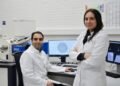
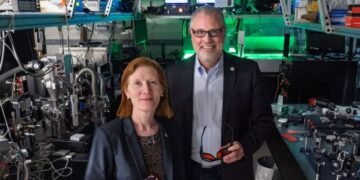
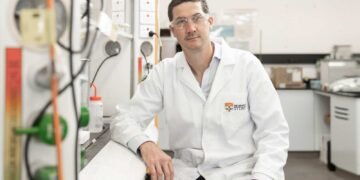
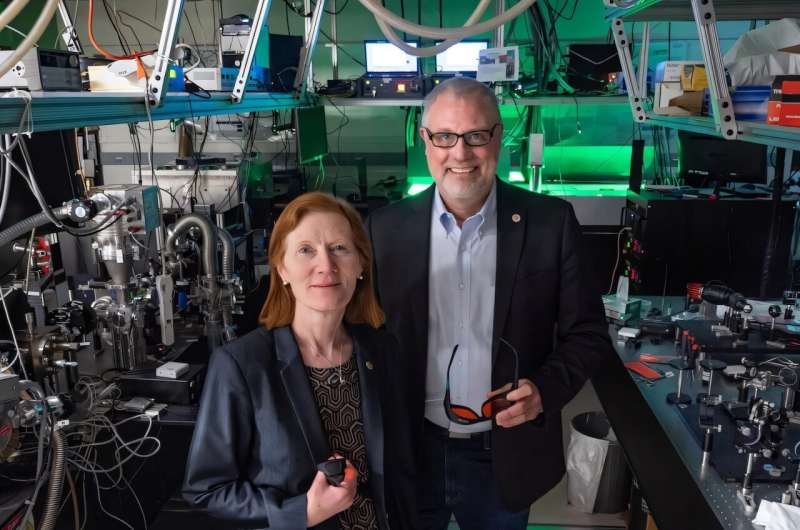
The project is led by physicists Henry Kapteyn and Margaret Murnane, who are fellows at JILA, a joint research institute between CU Boulder and the U.S. National Institute of Standards and Technology (NIST). Jeremy Thurston, who earned his doctorate in physics from CU Boulder in 2024, spearheaded the work on the new laser.
“Scientists have been working toward vacuum ultraviolet lasers for decades,” said Kapteyn, a professor in the Department of Physics. “We think we might have finally found a great route that can be scaled in power, and that is compact in size two essential requirements for challenging applications.
“The team will present their preliminary findings at sessions on March 17 and March 19 at the American Physical Society’s Global Physics Summit in Denver.
All light comprises very small waves, similar to the peaks and troughs in the ocean near shore. For visible light, these waves measure approximately 380 to 750 nanometers, equivalent to several millionths of an inch.
Scientists have long sought to develop better lasers that produce shorter wavelengths.
However, for decades, researchers have struggled to design lasers that emit bright beams in the vacuum ultraviolet (VUV) spectrum, where wavelengths range from about 100 to 200 nanometers, many times smaller than a human hair.
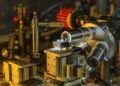
Murnane and Kapteyn’s laser is compact enough to fit on an ordinary desk, and the team aims to make it even smaller and more efficient.
“Shorter wavelengths matter because you can use them to create higher resolution microscopes,” said Murnane, a distinguished professor of physics. “If a chemical reaction is happening, you can see what molecules are there for example, how they ablate the tiles on a space capsule as it reenters the atmosphere.
More Efficient
“Murnane, Kapteyn, and their students are no strangers to powerful lasers.
The researchers previously pioneered the design of tabletop X-ray lasers, which emit beams oscillating more than a billion billion times per second.
However, laser scientists have faced difficulties breaking into the vacuum ultraviolet region, which is between X-rays and visible light. All kinds of matter from solids to atoms and organic molecules interact strongly with VUV light.
“Basically, everything absorbs light at this range, which is why vacuum ultraviolet is so interesting and why it’s so difficult to engineer,” Kapteyn noted.
To overcome these challenges, Kapteyn and Murnane’s team started with ordinary beams of red and blue laser light.
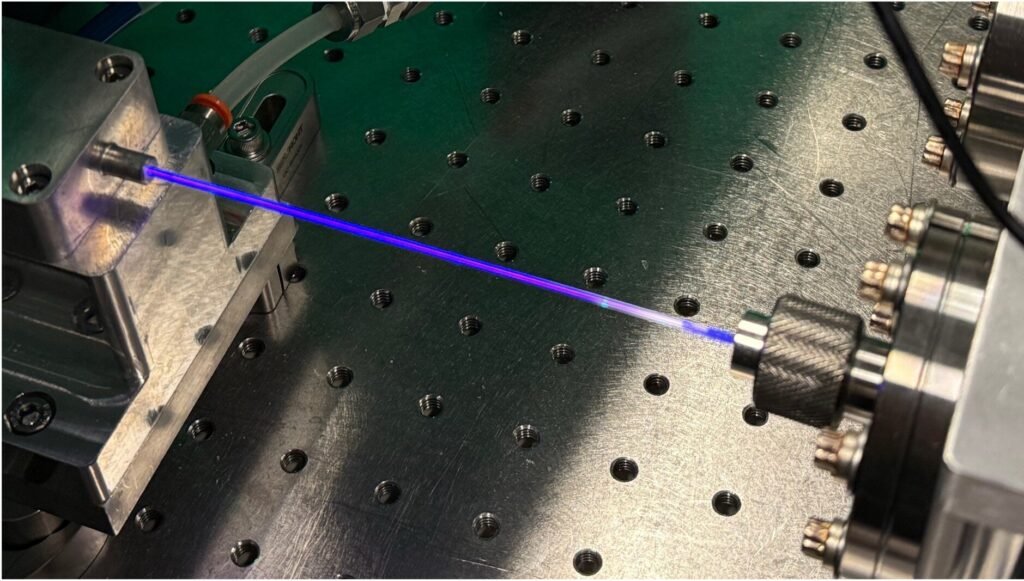
The team combined these beams in a special chamber called an “anti-resonant hollow core fiber.”
This chamber is similar to fiberoptic cables used to transmit internet data but is formed of a single hollow tube surrounded by seven smaller tubes, as the researchers liken it to the barrel of a revolver.
Laser light passes through the central tube, colliding with xenon gas atoms, which absorb and re-emit the light, transforming visible light into vacuum ultraviolet light.
“To our knowledge, no other approach, either at big or small facilities, has the VUV power levels, tuning ranges, and coherence that our new approach has shown,” Murnane said.
This could be highly beneficial. Many modern technologies increasingly rely on nanoelectronics, which include the semiconductors in computer chips found in phones and laptops.
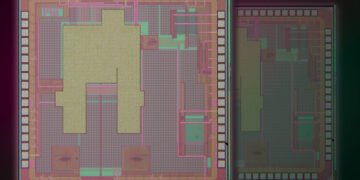
The team’s laser could help engineers optimize these devices by identifying tiny defects that might reduce their efficiency.
Nuclear Clocks
In their presentation, the researchers will also highlight how their approach could make robust and portable nuclear-referenced atomic clocks a reality. Murnane explained that if a cloud of thorium atoms is exposed to the laser at the precise wavelength, the atoms will begin to fluctuate in energy, similar to flicking the pendulum in a grandfather clock.
Scientists could track this oscillation to help with navigation on Earth and in space without GPS, or even to search for planets beyond our solar system.
Researchers led by physicist Jun Ye at JILA and NIST have already made significant progress in developing such clocks.Murnane added that thorium atoms “tick” only when exposed to light with a wavelength of exactly 148.3821 nanometers, within the VUV range.
Currently, generating this light requires large room-sized lasers. Murnane and Kapteyn believe their new laser could achieve the same effect more cheaply and efficiently.
The team still has a lot of work ahead. They are experimenting with ways to make their vacuum ultraviolet laser significantly smaller without reducing its efficiency is an engineering challenge.
“There are a lot of applications we would like to use VUV light for, but there haven’t been any practical lasers,” Murnane said. “Now, there’s a huge block of the spectrum being opened up where light is super sensitive to exquisite details of atoms, molecules, and materials.