













• Latest
  • Trending
  • All
Two chips to authenticate each other

Two chips to authenticate each other

February 21, 2026
Exploring materials at the atomic scale

Exploring materials at the atomic scale

February 21, 2026
Transistor-like membranes enhance ion separation

Transistor-like membranes enhance ion separation

February 20, 2026
Biomarker identifies the risk of liver cancer

Biomarker identifies the risk of liver cancer

February 19, 2026
Bacteria with a built-in compass.

Bacteria with a built-in compass

February 18, 2026

Fighting superbugs with nets and light switches

February 3, 2026
Reshaping gold leads to new electronic and optical properties

Reshaping gold leads to new electronic and optical properties

February 2, 2026

Using caffeine to edit gene expression

January 27, 2026
Students develop novel multi-metal 3D printing process.

Students develop novel multi-metal 3D printing process

September 4, 2025
Geometry revealed at the heart of quantum matter 

Geometry revealed at the heart of quantum matter

September 2, 2025
Wrinkles in atomically thin materials unlock ultra efficient electronics

Wrinkles in Atomically Thin Materials Unlock Ultra efficient Electronics

August 26, 2025
Researchers track the motion of a single electron during a chemical reaction

Researchers track the motion of a single electron during a chemical reaction

August 21, 2025

New method produces ultra-thin membranes

August 20, 2025
  • About
  • Advertise
  • Privacy Policy
  • Terms & Conditions
  • Contact
Saturday, February 21, 2026
  • Login
  • Register
Nanodigest
  • Home
  • Categories
    • Biological Science & Technology
    • Chemical Science & Technology
    • Material Science & Technology
    • Physical Science & Technology
    • Innovations & Education
  • NanoDigestExclusive
    Two chips to authenticate each other

    Two chips to authenticate each other

    Students develop novel multi-metal 3D printing process.

    Students develop novel multi-metal 3D printing process

    Ultra-fast, in-line atomic force microscope (AFM),

    New Ultra-fast, in-line Atomic Force Microscope (AFM)

    Sydney scholar Richard Payne honoured.

    Sydney scholar Richard Payne honoured

    AI and X-ray Vision to Gain Insight into Battery Electrolyte.

    AI and X-ray Vision to Gain Insight into Battery Electrolyte

    Emergence Quantum: a commercial quantum research 'special ops' team

    Emergence Quantum: a commercial quantum research ‘special ops’ team

    Couple satisfaction linked to fewer cognitive issues with chemo

    Ultrasound and Cilia to Clean Implanted Stents and Catheters

    Ultrasound and Cilia to Clean Implanted Stents and Catheters

    Celebrating Science

    Trending Tags

    • 2D nanospace
    • 3D nano structures
    • Bacterial magnetic nanoparticle
    • Creation of nano technology
    • nano particles
    • Nano Technology
    • Nano Tv
    • nanomaterials
    • nanoparticles
    • Nanosciences
    • nanotubes
    • Nanowire
  • Nano TvYouTube
    Nanotechnology in Engineering – NANOENGINEERING | Nano Tv

    Nanotechnology in Engineering – NANOENGINEERING | Nano Tv

    nanotechnology, materials, graphene, nano digest, NanoTV

    Nanotechnology in Materials – GRAPHENE | Nano Tv

    Nanotechnology in Electronics - NANOELECTRONICS | Nano Tv, Nano Digest

    Nanotechnology in Electronics-NANOELECTRONICS | Nano Tv

    Nanotechnology in Medicine - NANOMEDICINE, Nano Tv, nano digest

    Nanotechnology in Medicine-NANOMEDICINE | Nano Tv

    Molecular Nanotechnology-NANOTECHNOLOGY & IMPLEMENTATIONS | Nano Tv, It deals with engineering nanoscale machines that operate on the molecular scale distinct from other areas of nanotechnology, such as nanoscale materials, nano digest

    Molecular Nanotechnology-NANOTECHNOLOGY & IMPLEMENTATIONS | Nano Tv

    What are Nanoparticles?, nano digest

    What are NANOPARTICLES?: Nano Tv

    THE ORIGIN & CHALLENGE by Richard Feynman | Nano Tv

    THE ORIGIN & CHALLENGE by Richard Feynman: Nano Tv

    Introduction, NANOTECHNOLOGY, nano digest, Nano Tv

    Introduction to NANOTECHNOLOGY | Nano Tv

  • ShopSale
No Result
View All Result
Nanodigest
No Result
View All Result
Home Web Exclusive

Two chips to authenticate each other

Chip-processing method could assist cryptography schemes to keep data secure

by Nano Digest
February 21, 2026
in Web Exclusive
0
Two chips to authenticate each other

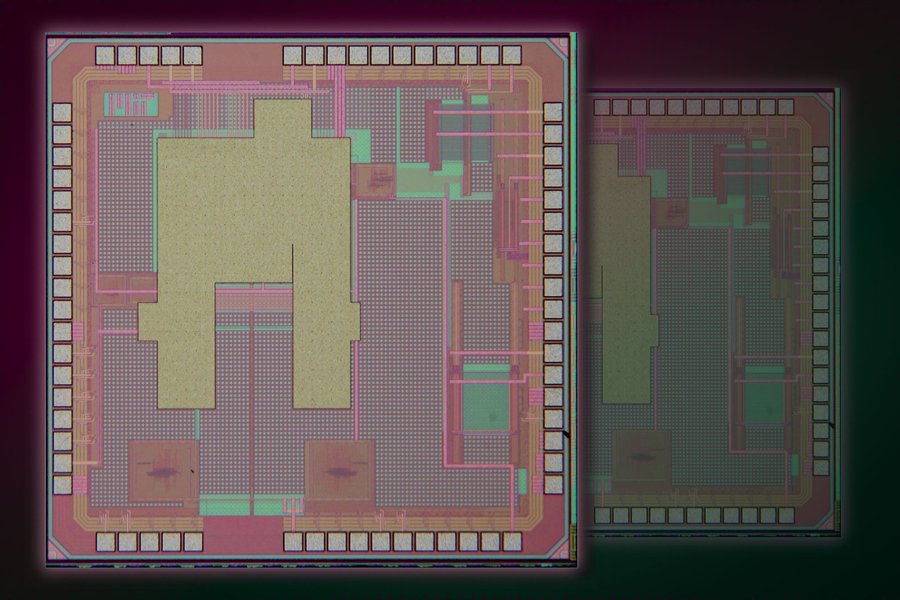
Each CMOS chip is slightly different due to microscopic, unavoidable variations during fabrication. These randomizations give each chip a unique identifier, known as a physical unclonable function (PUF). MIT researchers developed a matched PUF pair on two chips. Credits: Image: Courtesy of the researchers; MIT News.

491
SHARES
1.4k
VIEWS
Share on FacebookShare on TwitterShare on Whatsapp

Two chips to authenticate each other

Chip-processing method could assist cryptography schemes to keep data secure
By Adam Zewe

By enabling two chips to authenticate each other using a shared fingerprint, this technique can improve privacy and energy efficiency.

Just like each person has unique fingerprints, every CMOS chip has a distinctive “fingerprint” caused by tiny, random manufacturing variations. Engineers can leverage this unforgeable ID for authentication, to safeguard a device from attackers trying to steal private data.

But these cryptographic schemes typically require secret information about a chip’s fingerprint to be stored on a third-party server. This creates security vulnerabilities and requires additional memory and computation.

To overcome this limitation, MIT engineers developed a manufacturing method that enables secure, fingerprint-based authentication, without the need to store secret information outside the chip.

They split a specially designed chip during fabrication in such a way that each half has an identical, shared fingerprint that is unique to these two chips. Each chip can be used to directly authenticate the other. This low-cost fingerprint fabrication method is compatible with standard CMOS foundry processes and requires no special materials.

The technique could be useful in power-constrained electronic systems with non-interchangeable device pairs, like an ingestible sensor pill and its paired wearable patch that monitor gastrointestinal health conditions. Using a shared fingerprint, the pill and patch can authenticate each other without a device in between to mediate.

“The biggest advantage of this security method is that we don’t need to store any information. All the secrets will always remain safe inside the silicon. This can give a higher level of security. As long as you have this digital key, you can always unlock the door,” says Eunseok Lee, an electrical engineering and computer science (EECS) graduate student and lead author of a paper on this security method.

Lee is joined on the paper by EECS graduate students Jaehong Jung and Maitreyi Ashok; as well as co-senior authors Anantha Chandrakasan, MIT provost and the Vannevar Bush Professor of Electrical Engineering and Computer Science, and Ruonan Han, a professor of EECS and a member of the MIT Research Laboratory of Electronics. The research was recently presented at the IEEE International Solid-States Circuits Conference.

“Creation of shared encryption keys in trusted semiconductor foundries could help break the tradeoffs between being more secure and more convenient to use for protection of data transmission,” Han says. “This work, which is digital-based, is still a preliminary trial in this direction; we are exploring how more complex, analog-based secrecy can be duplicated — and only duplicated once.”

Leveraging variations

Even though they are intended to be identical, each CMOS chip is slightly different due to unavoidable microscopic variations during fabrication. These randomizations give each chip a unique identifier, known as a physical unclonable function (PUF), that is nearly impossible to replicate.

A chip’s PUF can be used to provide security just like the human fingerprint identification system on a laptop or door panel.

For authentication, a server sends a request to the device, which responds with a secret key based on its unique physical structure. If the key matches an expected value, the server authenticates the device.

But the PUF authentication data must be registered and stored in a server for access later, creating a potential security vulnerability.

“If we don’t need to store information on these unique randomizations, then the PUF becomes even more secure,” Lee says.

The researchers wanted to accomplish this by developing a matched PUF pair on two chips. One could authenticate the other directly, without the need to store PUF data on third-party servers.

As an analogy, consider a sheet of paper torn in half. The torn edges are random and unique, but the pieces have a shared randomness because they fit back together perfectly along the torn edge.

While CMOS chips aren’t torn in half like paper, many are fabricated at once on a silicon wafer which is diced to separate the individual chips.

By incorporating shared randomness at the edge of two chips before they are diced to separate them, the researchers could create a twin PUF that is unique to these two chips.

“We needed to find a way to do this before the chip leaves the foundry, for added security. Once the fabricated chip enters the supply chain, we won’t know what might happen to it,” Lee explains.

Sharing randomness

To create the twin PUF, the researchers change the properties of a set of transistors fabricated along the edge of two chips, using a process called gate oxide breakdown.

Essentially, they pump high voltage into a pair of transistors by shining light with a low-cost LED until the first transistor breaks down. Because of tiny manufacturing variations, each transistor has a slightly different breakdown time. The researchers can use this unique breakdown state as the basis for a PUF.

To enable a twin PUF, the MIT researchers fabricate two pairs of transistors along the edge of two chips before they are diced to separate them. By connecting the transistors with metal layers, they create paired structures that have correlated breakdown states. In this way, they enable a unique PUF to be shared by each pair of transistors.

After shining LED light to create the PUF, they dice the chips between the transistors so there is one pair on each device, giving each separate chip a shared PUF.

“In our case, transistor breakdown has not been modeled well in many of the simulations we had, so there was a lot of uncertainty about how the process would work. Figuring out all the steps, and the order they needed to happen, to generate this shared randomness is the novelty of this work,” Lee says.

After finetuning their PUF generation process, the researchers developed a prototype pair of twin PUF chips in which the randomization was matched with more than 98 percent reliability. This would ensure the generated PUF key matches consistently, enabling secure authentication.

Because they generated this twin PUF using circuit techniques and low-cost LEDs, the process would be easier to implement at scale than other methods that are more complicated or not compatible with standard CMOS fabrication.

“In the current design, shared randomness generated by transistor breakdown is immediately converted into digital data. Future versions could preserve this shared randomness directly within the transistors, strengthening security at the most fundamental physical level of the chip,” Lee says.

“There is a rapidly increasing demand for physical-layer security for edge devices, such as between medical sensors and devices on a body, which often operate under strict energy constraints. A twin-paired PUF approach enables secure communication between nodes without the burden of heavy protocol overhead, thereby delivering both energy efficiency and strong security. This initial demonstration paves the way for innovative advancements in secure hardware design,” Chandrakasan adds.

Source: MIT News

Tags: CMOS chipfingerprintMIT
Share196Tweet123Send
Nano Digest

Nano Digest

  • Trending
  • Comments
  • Latest

Nanotechnology in Cancer

September 10, 2020
Emergence of 2.5D Materials for Futuristic Applications

Emergence of 2.5D Materials for Futuristic Applications

June 29, 2022
New research methods developed for nano and quantum materials. Nano Digest.

New research methods developed for nano and quantum materials

February 24, 2023
Designing Gas detecting devices using nanomaterials. Nano Digest.

Designing Gas detecting devices using nanomaterials

2
3D Printing Allows Precise Light Control for Color Composition. nano Digest.

3D Printing Allows Precise Light Control for Color Composition

2

Wearable sensor monitors health, administers drugs using saliva and tears

1
Two chips to authenticate each other

Two chips to authenticate each other

February 21, 2026
Exploring materials at the atomic scale

Exploring materials at the atomic scale

February 21, 2026
Transistor-like membranes enhance ion separation

Transistor-like membranes enhance ion separation

February 20, 2026
Nanodigest

Copyright © 2009-2022 NanoDigest.in

Navigate Site

  • About
  • Advertise
  • Privacy Policy
  • Terms & Conditions
  • Contact

Follow Us

No Result
View All Result
  • Home
  • Biological Science & Technology
  • Chemical Science & Technology
  • Material Science & Technology
  • Physical Science & Technology
  • Innovations & Education
  • NanoDigest Exclusive
  • Nano Tv
  • —————————–
  • About
  • Advertise
  • Contact
  • Privacy Policy
  • Terms & Conditions

Copyright © 2009-2022 NanoDigest.in

Welcome Back!

Sign In with Google
OR

Login to your account below

Forgotten Password? Sign Up

Create New Account!

Sign Up with Google
OR

Fill the forms below to register

*By registering into our website, you agree to the Terms & Conditions and Privacy Policy.
All fields are required. Log In

Retrieve your password

Please enter your username or email address to reset your password.

Log In
We use cookies on our website to give you the most relevant experience by remembering your preferences and repeat visits. By clicking “Accept All”, you consent to the use of ALL the cookies. However, you may visit "Cookie Settings" to provide a controlled consent.
Cookie SettingsAccept All
Manage consent

Privacy Overview

This website uses cookies to improve your experience while you navigate through the website. Out of these, the cookies that are categorized as necessary are stored on your browser as they are essential for the working of basic functionalities of the website. We also use third-party cookies that help us analyze and understand how you use this website. These cookies will be stored in your browser only with your consent. You also have the option to opt-out of these cookies. But opting out of some of these cookies may affect your browsing experience.
Necessary
Always Enabled
Necessary cookies are absolutely essential for the website to function properly. These cookies ensure basic functionalities and security features of the website, anonymously.
CookieDurationDescription
cookielawinfo-checkbox-analytics11 monthsThis cookie is set by GDPR Cookie Consent plugin. The cookie is used to store the user consent for the cookies in the category "Analytics".
cookielawinfo-checkbox-functional11 monthsThe cookie is set by GDPR cookie consent to record the user consent for the cookies in the category "Functional".
cookielawinfo-checkbox-necessary11 monthsThis cookie is set by GDPR Cookie Consent plugin. The cookies is used to store the user consent for the cookies in the category "Necessary".
cookielawinfo-checkbox-others11 monthsThis cookie is set by GDPR Cookie Consent plugin. The cookie is used to store the user consent for the cookies in the category "Other.
cookielawinfo-checkbox-performance11 monthsThis cookie is set by GDPR Cookie Consent plugin. The cookie is used to store the user consent for the cookies in the category "Performance".
viewed_cookie_policy11 monthsThe cookie is set by the GDPR Cookie Consent plugin and is used to store whether or not user has consented to the use of cookies. It does not store any personal data.
Functional
Functional cookies help to perform certain functionalities like sharing the content of the website on social media platforms, collect feedbacks, and other third-party features.
Performance
Performance cookies are used to understand and analyze the key performance indexes of the website which helps in delivering a better user experience for the visitors.
Analytics
Analytical cookies are used to understand how visitors interact with the website. These cookies help provide information on metrics the number of visitors, bounce rate, traffic source, etc.
Advertisement
Advertisement cookies are used to provide visitors with relevant ads and marketing campaigns. These cookies track visitors across websites and collect information to provide customized ads.
Others
Other uncategorized cookies are those that are being analyzed and have not been classified into a category as yet.
SAVE & ACCEPT
This website uses cookies. By continuing to use this website you are giving consent to cookies being used. Visit our Privacy and Cookie Policy.