


















Gold Nanoparticles That Behave Like a Liquid
When inorganic nanoparticles aggregate, their optical, electronic, and magnetic properties are highly dependent on their arrangement.
The ability to control these arrangements could offer a powerful method for fine-tuning material properties.
A research team led by Dr. Rina Sato (formerly of IMRAM, Tohoku University; currently at ICYS, NIMS) and Professor Kiyoshi Kanie (SRIS, Tohoku University) has discovered that gold nanoparticles at the air/water interface can dynamically reorganize in response to temperature changes and mechanical compression.
The study reveals, for the first time, that small changes in the distribution of organic molecules on nanoparticle surfaces can trigger large-scale structural transformations across an entire nanoparticle layer.
In dry environments, organic molecules attached to nanoparticle surfaces typically have limited mobility, and structural changes often require temperatures above 100 °C.
To address this challenge, the researchers focused on the air/water interface, where nanoparticles coated with hydrophobic molecules naturally form two-dimensional layers.
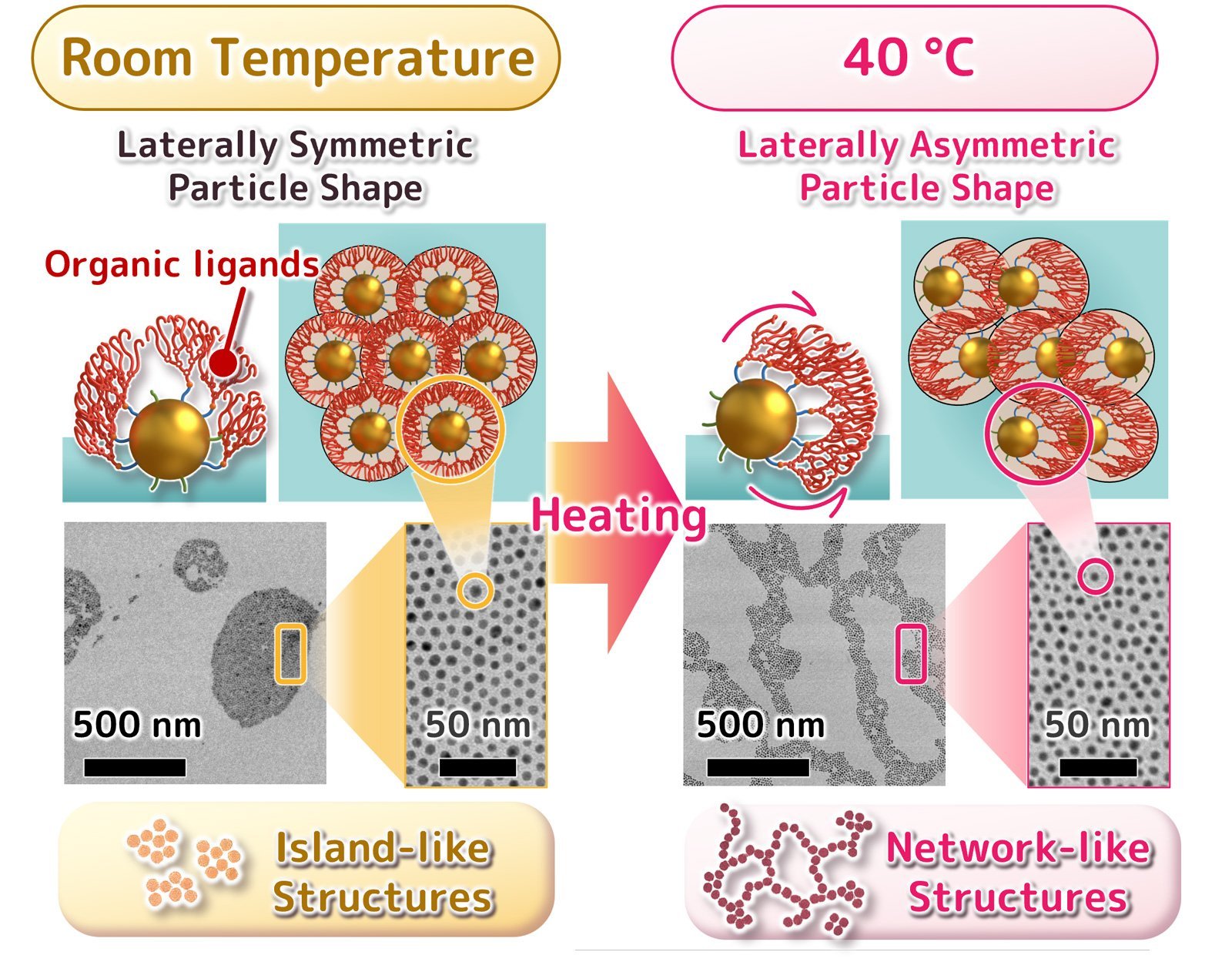
The team synthesized gold nanoparticles coated with two different types of organic molecules: a temperature-responsive dendritic liquid-crystal molecule known as a “dendron,” and a simple linear-chain ligand.
They then examined how these nanoparticles behaved when the temperature increased and when the nanoparticle layer was mechanically compressed.
The researchers observed highly dynamic, liquid-like behavior.
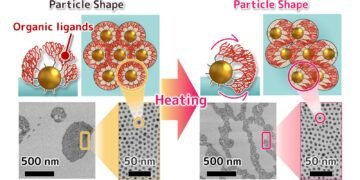
At room temperature, the nanoparticles formed isolated island-like structures. As the temperature increased, these structures gradually transformed into chain-like arrangements and then into large network-like patterns at around 40 °C. When the layer was compressed, the network structures returned to island-like domains.
Using X-ray measurements at the DESY synchrotron facility in Hamburg, the team identified the mechanism behind this behavior.
The two types of surface molecules spontaneously redistributed across the nanoparticle surface in response to external stimuli. This altered the apparent symmetry of the nanoparticles, driving the large-scale reorganization of the entire assembly.
“This work demonstrates how very small molecular-level changes can lead to dramatic structural transformations in nanoparticle systems,” said Kanie.
“We believe this finding opens a new pathway for designing smart and adaptive materials that respond dynamically to their environment.”
The findings show how subtle molecular movements can control the collective behavior of nanoparticle systems, offering a new strategy for designing responsive surfaces and materials.
Since the structural changes occur near physiological temperatures, the research could contribute to future biomedical technologies, including drug delivery systems that respond to local temperature differences, such as those found around tumors. The work may also support the development of adaptive materials for microfluidic devices and other next-generation nanotechnologies.
These findings were published in the Journal of the American Chemical Society on May 1, 2026.
Source: Tohoku University