


















Researchers systematically revealed lattice-driven topological spin structures
A group led by Professor LU Qingyou from the High Magnetic Field Laboratory at the Hefei Institutes of Physical Science, Chinese Academy of Sciences, along with Professors LUO Xuan and SUN Yuping from the Institute of Solid State Physics, studied Cr2Ge2Te6 single crystals.
They used a special microscope that works at very low temperatures and strong magnetic fields, developed in-house, based on the Steady High Magnetic Field Facility.Their findings were published as a cover story in the journal Advanced Functional Materials.
Topological spin structures are interesting because they are stable and can be changed, making them useful for new tech. Usually, these structures are thought to come from magnetic forces and outside influences. But it wasn’t clear if the arrangement of atoms could directly shape them in layered magnets.
In this study, the team looked at Cr2Ge2Te6, a material with layered structure, strong magnetic orientation, and strong interaction between layers. These qualities make it a good model for studying two-dimensional magnetism and spin structures.
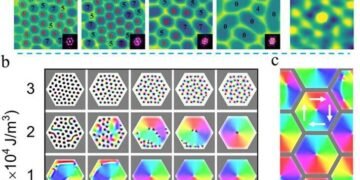
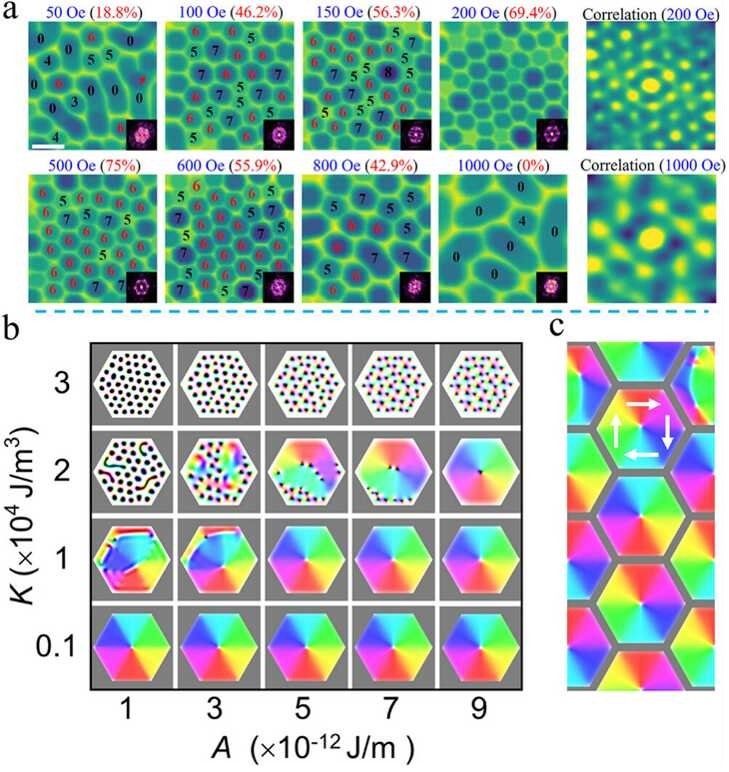
Images from the microscope showed clear topological spin structures in different shapes, like triangles and octagons.
When they combined this with other tests and computer models, they found these structures were connected to the material’s atomic arrangement and small changes in structure, not random.
The findings suggest that the lattice can create different energy states that help form and keep these spin structures. This is different from what people usually think, which is that these structures are mainly made by interactions at the edges.
Further tests showed that these structures could change when exposed to magnetic fields. Some structures could switch between different types, and others could split or join, showing they can be controlled by magnetic fields.
This study shows how the crystal structure and magnetic properties are connected, offering new ways to understand magnetic behavior in thin materials.
Source: Hefei Institutes of Physical Science