















A Highly Sensitive Quantum Microscope Developed
A team of international researchers has developed a highly sensitive quantum microscope, enabling the first direct observation at room temperature of how electrons interact with each other in graphene.
This breakthrough confirms a long-standing theoretical prediction with high precision and is published in the journal Nano Letters.
The research was led by Dmitri Efetov, Professor of Experimental Solid State Physics at LMU München’s Faculty of Physics and MCQST co-coordinator for Research Area Quantum Matter.
In recent years, “moiré materials”—atomically thin, two-dimensional layered structures such as graphene—have become one of the most promising areas in condensed matter physics.
By stacking these layers with a slight rotational misalignment, researchers create interference patterns that significantly alter electron behavior.
This simple twist can lead to entirely new quantum phases, including superconductivity and correlated insulating states, making moiré systems a powerful platform for studying emergent physical phenomena.
However, studying such systems has traditionally been challenging.
Conventional devices require extreme precision in fixed twist angles, often to within a tenth of a degree. Even with such precision, issues like strain and disorder can obscure the underlying physics.
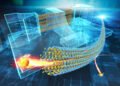
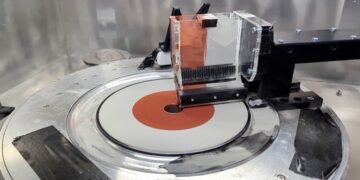
The quantum twisting microscope (QTM)—recently developed by researchers at the Weizmann Institute—offers a novel approach.
By mechanically separating two-dimensional layers and rotating them in place, the QTM enables continuous, dynamic control of the twist angle, eliminating the constraints of traditional fabrication methods.
Pushing the boundaries of precision
The QTM has already shown its ability to directly map electronic band structures, probe phonons, and visualize moiré potentials.
In this new study, the LMU team—only the second group globally to achieve the QTM—has significantly improved the instrument’s resolution by incorporating a hexagonal boron nitride tunneling layer.
This advancement allows the detection of subtle deviations from graphene’s ideal linear energy spectrum, which are signatures of electron-electron interactions visible as distinct features in the tunneling maps.
What makes the result particularly remarkable is that these interaction effects are observed at room temperature. In this regime, such delicate quantum corrections are usually lost due to thermal noise.
The findings not only confirm the persistence of strong electron interactions in graphene but also highlight the extraordinary sensitivity and precision of the QTM platform.
With dynamic twist control and unprecedented resolution, this technique is set to become a key tool for exploring complex quantum states across moiré and other two-dimensional material systems.
Source: Ludwig Maximilian University of Munich (LMU)