


















Ethanol vs. Gasoline, A Balanced Look
By Team Nanodigest
What is Ethanol Fuel?
Ethanol is a renewable, alcohol-based biofuel primarily made by fermenting the sugars found in crops like corn, sugarcane, and barley. In the automotive industry, it is commonly blended with gasoline—such as E10 (10% ethanol, 90% gasoline) or E85 (up to 85% ethanol for flexible-fuel vehicles).
Advantages of Using Ethanol
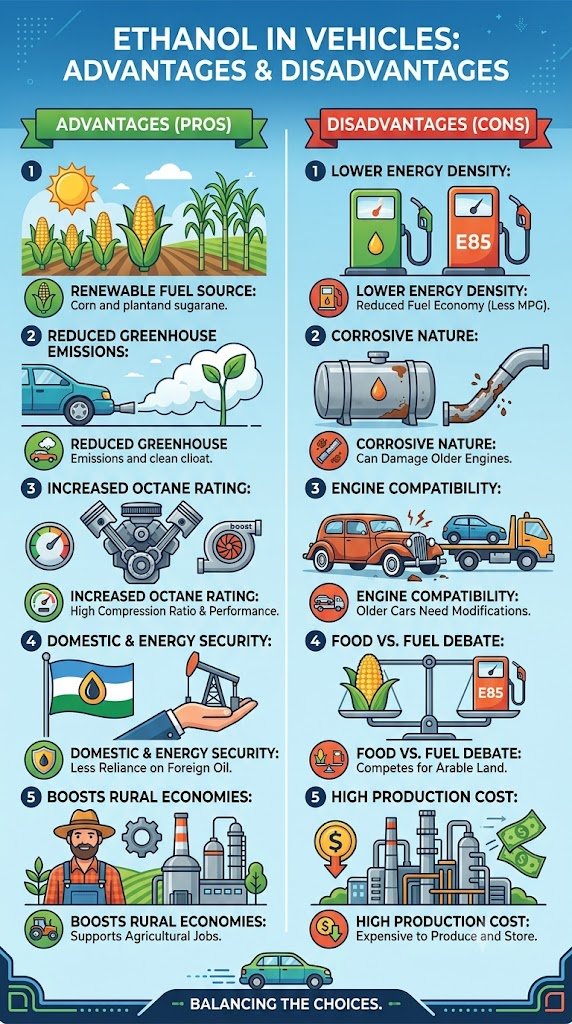
Environmental Benefits: Reduced Greenhouse Gas Emissions: Because the crops grown to produce ethanol absorb carbon dioxide as they grow, the overall lifecycle emissions of ethanol are significantly lower than those of pure fossil fuels.
Cleaner Combustion: Ethanol contains oxygen in its chemical structure, which helps the fuel burn more completely. This results in lower tailpipe emissions of harmful pollutants like carbon monoxide and particulate matter.
Economic and Energy Security: Renewable and Domestic Resource: Unlike crude oil, which is a finite resource often imported from politically unstable regions, ethanol can be grown and produced locally. This reduces a nation’s dependence on foreign oil.
Boost to Agricultural Economies: Ethanol production supports rural economies by creating a steady demand for commercial crops and generating jobs in refining and distribution.
Engine Performance: High Octane Rating: Ethanol has a higher octane rating than standard gasoline. This allows engines to run at higher compression ratios, preventing engine knocking and providing a slight boost in horsepower and performance, particularly in turbocharged or high-performance vehicles.
Disadvantages of Using Ethanol
Lower Energy Density: Reduced Fuel Economy: Ethanol contains roughly 30% less energy per gallon than pure gasoline. As a result, vehicles running on high-ethanol blends like E85 will experience a 15% to 25% drop in miles per gallon (MPG), meaning you have to fill up the tank more frequently.
Engine and Infrastructure Damage: Corrosive Nature: Ethanol is highly hygroscopic, meaning it readily absorbs water from the air. This moisture can separate from the fuel (phase separation) and cause corrosion in steel fuel tanks, fuel lines, and fuel injectors.
Incompatibility with Older Engines: While modern vehicles are designed to handle E10 or E15, older cars, small engines (like lawnmowers and boats), and vintage vehicles can suffer severe damage as ethanol degrades rubber seals, gaskets, and plastic components.
The Food vs. Fuel Debate: Impact on Food Prices: Diverting massive amounts of arable land and crops (like corn) toward fuel production instead of food can drive up global food prices and cause supply chain strains.
High Environmental Footprint in Production: While burning ethanol is cleaner, producing it requires significant amounts of water, synthetic fertilizers, and fossil-fueled farming equipment, which can partially offset its overall environmental benefits.
The Bottom Line
Ethanol serves as an excellent stepping stone for reducing immediate carbon emissions and decreasing reliance on fossil fuels. However, its lower energy efficiency and potential for engine wear mean that it requires specialized vehicle engineering (like Flex-Fuel technology) to be used effectively at higher concentrations.