










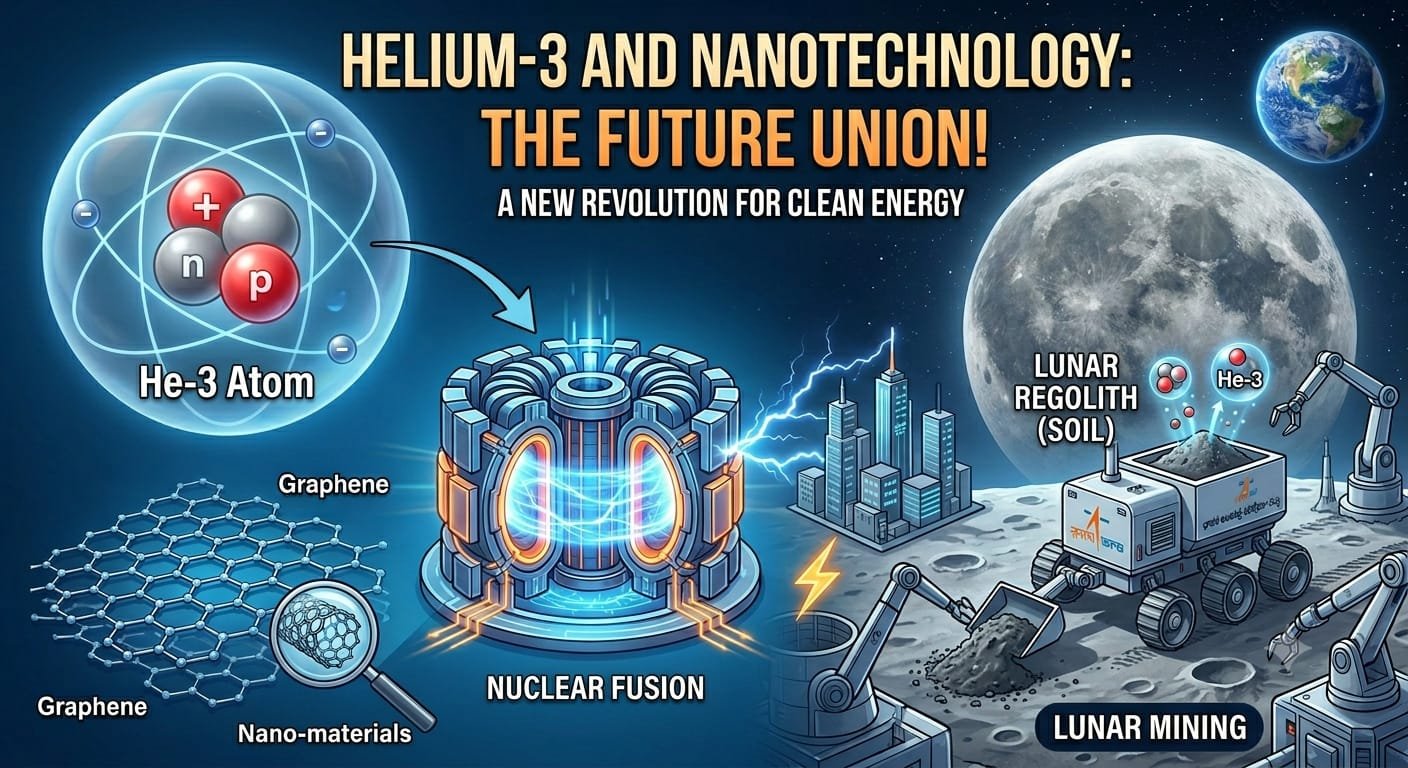
Helium-3 and Nanotechnology
The Power Couple Ready to Transform the Future!
The global quest for clean, sustainable energy has never been more urgent. With the looming threats of climate change, rising pollution, and depleting fossil fuels, scientists are looking beyond Earth for solutions—specifically, toward the Moon. A rare isotope found on the lunar surface, Helium-3, is being hailed as the ultimate fuel that could power human civilization for centuries.
However, extracting this lunar treasure and utilizing it on Earth presents monumental engineering challenges. This is where Nanotechnology steps in. The convergence of Helium-3 and nanotechnology is set to spark the next big technological revolution. Here is how this incredible partnership works.
What is Helium-3, and Why is it on the Moon?
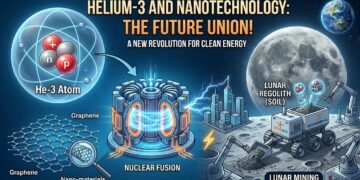
On Earth, the helium we use in balloons is Helium-4, which contains two protons and two neutrons. Helium-3, however, is a lighter isotope containing two protons and only one neutron. It is generated by the Sun and carried across space via solar winds.
- Why isn’t it on Earth? Earth is protected by a powerful magnetic field and a thick atmosphere. This protective shield deflects solar winds, preventing Helium-3 from reaching our planet.
- Why is it abundant on the Moon? The Moon lacks both an atmosphere and a magnetic field. For billions of years, solar winds have bombarded the lunar surface uninterrupted, embedding vast amounts of Helium-3 directly into the lunar soil (regolith).
Nuclear Fusion: The Ultimate Clean Energy
Current nuclear power plants rely on Nuclear Fission—the process of splitting heavy atoms like Uranium. While efficient, fission leaves behind dangerous, long-lasting radioactive waste.
Helium-3 enables Nuclear Fusion (specifically, aneutronic fusion) when combined with Deuterium (an isotope of hydrogen). When these atoms fuse at extreme temperatures, they release massive amounts of energy.
The Ultimate Advantage: Unlike traditional nuclear reactions, this process does not produce high-energy neutrons, meaning zero radioactive waste and zero pollution. It is so safe that fusion reactors could theoretically be built right in the middle of major cities.
The Critical Role of Nanotechnology
While Helium-3 fusion sounds like a dream, turning it into reality requires overcoming extreme physical limitations. Nanotechnology provides the key to solving these challenges:
1. Ultra-Resistant ‘Nano-Materials’ for 100-Million-Degree Heat
To trigger Helium-3 fusion, the reactor must reach temperatures exceeding 100 million degrees Celsius—hotter than the core of the Sun! No conventional material on Earth can withstand this heat without melting instantly.
Scientists are using nanotechnology to engineer reactor walls lined with Carbon Nanotubes and Graphene. These ultra-strong nano-structured materials possess extraordinary thermal conductivity and mechanical strength, allowing them to contain the ultra-hot plasma without degrading.
2. ‘Nano-Filters’ to Mine Lunar Soil
Helium-3 does not exist in pure gas pockets on the Moon; it is trapped inside microscopic pockets within the lunar dirt.
To extract it efficiently without hauling tons of useless dirt back to Earth, researchers are developing nano-membranes (nano-filters). The pores of these filters are engineered at the atomic scale to allow only Helium-3 atoms to pass through, seamlessly separating the precious gas from the lunar soil.
3. Lightweight Spacecraft for Transport
Mining the Moon requires sending heavy machinery into space and bringing the fuel back. Every kilogram of weight adds millions to rocket launch costs. Advanced lightweight nano-composites allow aerospace engineers to build spacecraft that are incredibly light yet stronger than steel, making lunar mining economically viable.
Conclusion
The potential of this cosmic resource is staggering. Scientists estimate that just a few economic payloads of Helium-3 could power the entire planet for a whole year. This immense potential is precisely why space agencies like NASA, China’s CNSA, and India’s ISRO are targeting the lunar south pole for future missions.
Ultimately, by combining the cosmic fuel of the Moon—Helium-3—with Earth’s most precise engineering feat—Nanotechnology—humanity is on the verge of solving its energy crisis forever.